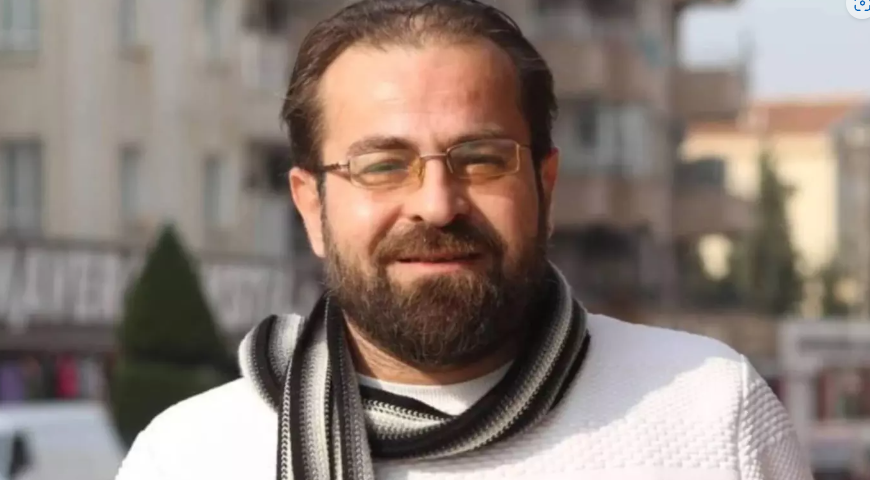
A Turkish newspaper reported on Tuesday that a Turkish court arrested Ahmed Katie, a Syrian activist and businessman, in December for spying for the French intelligence agency. Katie disappeared in late November for more than two weeks before his lawyers were informed by Turkish security forces that he was taken to the police station in mid-December for an official questioning on his activities. According to Sabah newspaper, which cited sources with information on his case, Katie was recruited by the Directorate-General for External Security (DGSE), a French intelligence agency, which allegedly promised him and his family asylum for services. The report said Katie was to give “false” information to French officials about Turkey’s treatment of Syrian refugees and its immigration policies, “which would cause trouble for Turkey in Europe”. The report said Katie was the leader of a three-person intelligence group and was tracked by the Turkish Intelligence, MIT, for a year. Katie received the instructions from the directors of a Paris-based NGO, which is controlled by the DGSE.
In a phone interview with Middle East Eye, Katie’s lawyer Halim Yilmaz said his client was not a spy for French intelligence and that they would challenge the allegations in court. Yilmaz said Katie had been in custody since 12 December on espionage charges. The court said his phone and computer were still being examined, so he had to stay in custody. Turkish officials did not comment.
Katie, born in Saudi Arabia to a family from Idlib known for its opposition to the Syrian government, has a history of confrontations with Bashar al-Assad’s regime.
Ironically, his first arrest in 2005 occurred amid a government-declared amnesty for dissidents and their families. He was detained in Deraa, only to spend a year in the notorious Sednaya prison.
Katie was later arrested in 2011 after participating in protests against Assad in the Idlib province. After his release, he moved to Turkey as a refugee and secured a work permit.
Over the years, the activist became a prominent advocate for Syrian refugees and is well-known among Syria’s four-million diaspora in Turkey, where he has been residing for nearly a decade.
A Turkey-based source, who is closely following Katie’s case, told MEE that Turkish intelligence officers met the activist on 19 October at a cafe in Istanbul and questioned him on his activities.
Bizarrely, he added, the officers asked him to buy a SIM card in his name from a store next door and hand it over to them.
On 29 October, Katie announced on his Facebook page that he had put a total stop to his human rights and media activities.
He also filed a petition to the Istanbul prosecutor’s office to make clear that he only has two telephone numbers, and does not use others, such as the one he was forced to purchase in October, the source added.
Seeking asylum in France
Yilmaz, the lawyer, said the security forces have been targeting people who are known for their human rights activism in recent years, especially if they were refugees or have connections to organisations abroad, falsely accusing them of being informants of spies.
He mentioned the Buyukada case, where many activists from mainstream NGOs, such as Amnesty International, have stood trial for years over conspiratorial charges.
The source said Katie was unhappy in recent years because of the growing anti-refugee sentiment in Turkey, and he worried about raising his two children there. The source said, “He is thankful to Turkey but the refugees were treated very badly, he couldn’t keep quiet and he was speaking out against the Turkish government.” Katie applied for political asylum at the French consulate in Istanbul, using a rare option given by Paris to those who live outside France. Most countries need people to first get to the host country before applying. The source said, “He needed a sponsor under French law, and he reached out to the NGO, Friends of Aleppo Collective, or Collectif des Amis d’Alep, through his friends who live abroad.” The source said, “He had a connection there and told the person about his activities and applied to the consulate because he felt unsafe in Turkey.
The source said Katie only submitted open-source data and his articles were not secret to the consulate and the NGO. Katie wanted to speed up his application after he met Turkish security personnel in Istanbul in October, fearing he would be arrested. The source said, “He got a visa and was supposed to leave on 8 December, but he was caught in November before that date.” MEE contacted the French NGO but did not get a response by the time of publication. The Sabah report, based on the court case, claimed that Katie gave false information on Syrian refugees in Turkey to foreign TV channels, including an incident on the Turkish-Greek border. The report said Katie blamed Turkish border guards for throwing 55 migrants into the river. The report also said Katie secretly got personal biographical information from the addresses of foreign citizens in Turkey and gave it to French intelligence. The French embassy in Ankara did not comment.