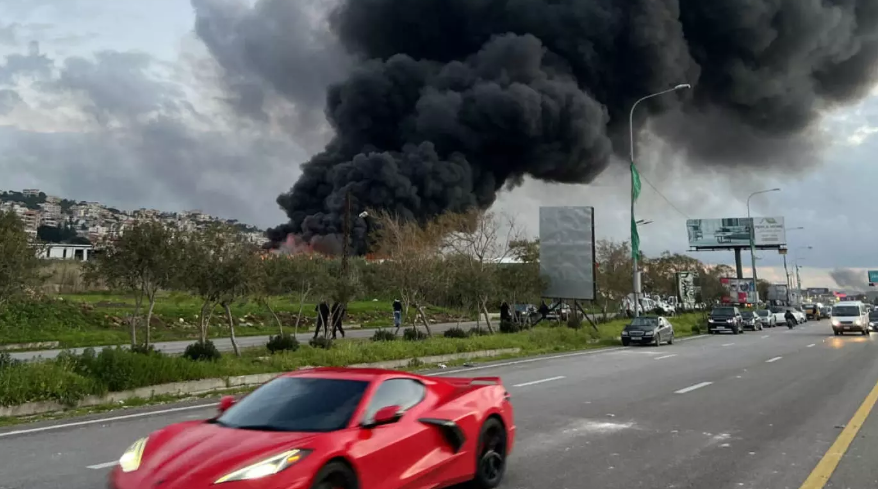
On Monday, Israeli air strikes hit southern Lebanon near the port city of Sidon, with video showing one explosion sending flames and debris close to a highway with civilian vehicles.
The Israeli military said the strikes were aimed at arms storage facilities near Sidon in southern Lebanon, in response to a Hezbollah drone that entered Israel, an Israeli military spokesperson said on Monday. “We found an unmanned aerial vehicle from Hezbollah near Tiberias, which apparently flew in today and crashed near Tiberias,” Rear Admiral Daniel Hagari said on a televised news briefing. “We attacked weapons depots near Sidon as a response to this activity.” The strikes were one of Israel’s deepest incursions into its Mediterranean neighbor’s land, as it trades fire with Hezbollah, backed by Iran. A video from a balcony showed two mushroom cloud explosions rising from a civilian area near the Mediterranean Sea.
The fighting between Hezbollah and Israel has mostly stayed in the area near Israel’s northern border with Lebanon, about 20 miles from Sidon, since October.
The strike on Ghaziyeh on Monday, where a big fuel refinery is located and which is only five kilometres from Sidon’s centre, showed how quickly the fighting can worsen.
Sidon and Palestinian resistance The strikes are an escalation in the border war between Hezbollah and Israel, but this area has been hit before.
Hezbollah and Amal, the other main Shia party in Lebanon, have a strong presence in southern Lebanon.
The region has been a base for many Palestinian armed groups since the 1960s.
Israel attacked Ghaziyeh in the 2006 war, killing 26 civilians. In 2018, Israel was suspected of a failed car bombing that aimed at Hamas official Mohamed Hamdan in Sidon.
Before the Gaza war started, the Ain el-Hilweh refugee camp near Sidon, a southern coastal city, had violent clashes between fighters from the Fatah movement and the Shabab al-Muslim (Muslim Youth) coalition.
US and European officials have been working for months to get an agreement between Israel and Hezbollah to stop the fighting.
But former senior US officials told MEE that Israel is using the chance to change the rules of engagement with Hezbollah that have controlled past conflicts between them, because they think Hezbollah does not want a bigger war with Israel.
In January, Israel killed senior Hamas official Saleh al-Arouri in a Hezbollah stronghold in Beirut.
The Israeli military said it killed a Hezbollah commander, his deputy and a fighter, in a strike in Nabatiyeh, a city in south Lebanon, last week. But Israel’s strikes have started to hurt civilians more. Last week, Israeli strikes on villages in southern Lebanon killed 10 people, six of them children, AFP reported. Hezbollah chief Hassan Nasrallah said on Friday that Israel would pay “with blood” for killing civilians in Lebanon recently, and said the group had missiles that could hit any place in Israel. He said his movement, backed by Iran, has “precision-guided missiles that can reach… Eilat” on Israel’s Red Sea coast, far from the northern towns it usually hits.
The violence has increased recently, and people are afraid of another big war between Israel and Hezbollah like in 2006. According to an AFP count, cross-border attacks have killed at least 269 people on the Lebanese side since October, mostly Hezbollah fighters but also 40 civilians. The Israeli army said 10 soldiers and six civilians have died on the Israeli side.