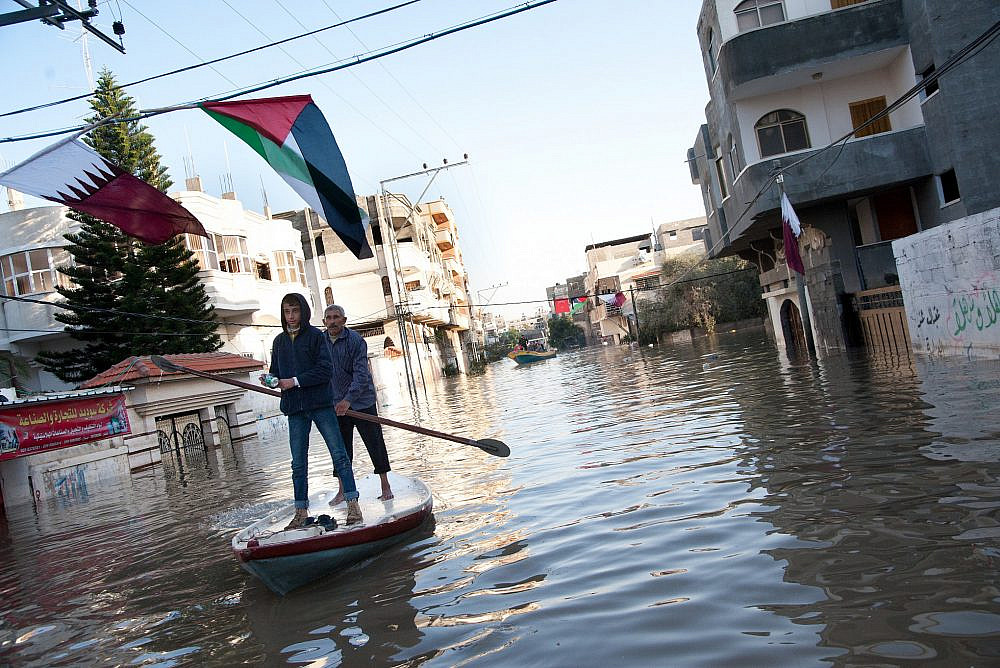
Palestinians faced new worries and difficulties today as heavy rain fell in Gaza, where many of them have no homes and live in temporary tents after Israeli attacks for weeks.
The fear of disease spreading and the sewage system collapsing grew as the rainy season started and flooding became a possibility.
The rain caused distress for the people who had to leave their homes and found their clothes soaked by rain in the morning at a UN shelter in Khan Younis in southern Gaza.
Fayeza Srour, who fled to the south when Israel launched its military campaign after Hamas fighters stormed into southern Israel from Gaza on October 7, said, “We used to live in a concrete house and now we are in a tent.”
The tent, the wood and the nylon tarps will not withstand any flooding… Where will the people sleeping on the floor go? What will they do?”
Flooding sometimes occurs in Gaza, where winters are cold and wet.
Karim Mreish, another Gazan who had to leave his home, said people at the shelter were hoping for the rain to end.
- He said, “Those children, those women, those elderly hope God will spare them from rain. If it rains, it will be very hard and no words can express our pain.”
The World Health Organisation (WHO) warned last week that disease could spread more in Gaza because the health system was disrupted by Israeli air attacks, access to clean water was limited and people crowded in shelters.
Today, it expressed worry about the possibility of rain leading to flooding and overloading the already poor and damaged sewage facilities.
“We have already seen outbreaks of diarrhoeal diseases,” WHO spokesperson Margaret Harris said in Geneva.
She said there were over 30,000 cases of diarrhoea in a time when WHO would usually expect 2,000 cases.
“We have so much damage to the infrastructure. We have a shortage of clean water. We have people packed very tightly together. This is another reason why we are pleading for a ceasefire to happen now,” she said.
Ahmed Bayram, a spokesperson for the Norwegian Refugee Council, said the beginning of the rainy season could be “the hardest week in Gaza since the (military) escalation started.”
“Heavy rains will make it more difficult for people and rescue teams to move,” he said. “It will be harder to rescue people trapped under the rubble, or to bury the dead, all of this while the bombardment and the fuel crisis continue.”
The ‘here and now’
Israel promised to destroy Hamas after the October 7 attack, in which Israel said over 1,200 people died and about 240 were captured. Medical officials in Gaza, which is run by Hamas, say over 11,000 people have died in Israeli strikes since then.
Aid organisations have been unable to plan for the problems caused by rain and flooding, given the huge scale of the humanitarian needs of Gaza’s 2.3 million people.
Juliette Touma, Director of Communications at the UN Palestinian refugee agency (UNRWA), said the organisation was focused on meeting the population’s needs “here and now.”
“We can barely cope from one hour to the next ourselves, because the situation on the ground is so, so, so desperate,” she said.
Touma said even a little rain could flood the streets of Gaza, because the sewage system could not handle water.
“This is on a normal day. This is not when half of Gaza, or more, is in rubble,” she said.
The International Committee of the Red Cross (ICRC) said it had also been unable to plan beyond Gazans’ daily needs. “The situation is so unstable and complex because of the hostilities that we have focused very clearly on the humanitarian consequences as they change from one day to the next,” said William Schomburg, head of the ICRC delegation in Gaza.