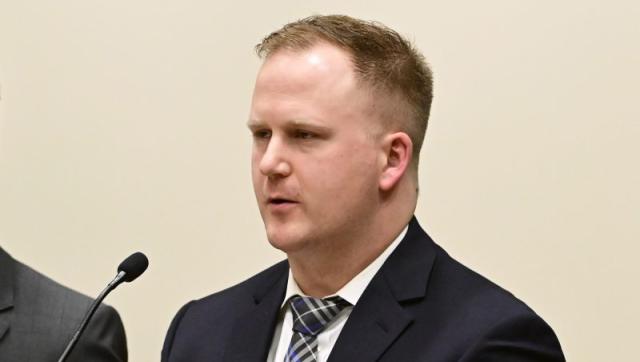
A suspended Aurora officer has been cleared of charges in the 2019 death of Elijah McClain, a 23-year-old Black man who died after Aurora, Colorado, police officers pinned him with a carotid hold and paramedics gave him a powerful sedative.
Nathan Woodyard was charged with and acquitted of reckless manslaughter and criminally negligent homicide after a two and a half week trial for the 2019 death of Elijah McClain. The jury deliberated for less than a day and returned the verdict on Monday, Nov. 6, around 3 p.m.
The trial centered on what killed McClain, who was stopped by police on Aug. 24, 2019, as he walked home from a store. He was wearing a black ski mask and listening to music, which someone reported as suspicious to 911. The police officers quickly got physical with McClain.
McClain had a cardiac arrest and never woke up. He died six days after the police stop.
Woodyard was the first officer who tried to stop McClain and applied a carotid hold shortly after the police stop began. Another officer also tried to use a carotid hold on McClain but failed.
Woodyard is the second officer to be found not guilty in McClain’s death.
Woodyard’s defense blamed paramedics Woodyard’s defense lawyers argued that the officer’s forceful hold did not kill McClain. They blamed the paramedics, who injected McClain with ketamine.
The Adams County Coroner’s Office, which did McClain’s autopsy, said in its first report that his cause of death was “undetermined.” Later, the Adams County chief coroner changed the report, but the cause of death is still undetermined.
“This 23-year-old, African American male, Elijah McClain, died of complications of ketamine administration following forcible restraint,” the coroner’s office said after reviewing all the material.
Woodyard also spoke in his own defense, saying he was sorry for his actions and would do things differently if he could go back to the same situation.
The suspended officer said the situation got worse when one of the other officers on the scene said McClain reached for an officer’s gun. Woodyard said that’s when he decided to use the carotid hold.
“I didn’t know a lot before the carotid. I didn’t know if a gun was out of the holster. I didn’t know if it would go off any second,” Woodyard said. “I thought I would get shot, and I thought I’d never see my wife again.”
He said that when he left the scene, McClain was still awake and talking to officers.
The Aurora Police Department has banned the carotid hold, but it was a hold officers learned in 2019.
Prosecution said ketamine was a factor The prosecution said that Woodyard used the carotid hold on McClain only moments after stopping him.
They called Dr. David Beuther, a lung doctor, who said the carotid hold started a series of events that made it harder for McClain to survive. He said McClain was in a position that made it hard for him to breathe, which made him choke on his vomit before the ketamine injection.
Dr. Roger Mitchell, a forensic pathologist, said that law enforcement’s injuries caused McClain’s death and said he was clearly in trouble because body camera footage showed he had trouble breathing and looked like he was choking.
Mitchell said the officer who said McClain “can breathe” on the body camera was wrong because McClain was having trouble breathing and could not answer when asked if he was okay.
“He’s not okay, as a medical professional, that’s what his lack of response tells me,” Mitchell said.
Third officer on trial for Elijah McClain’s death. One officer convicted, one cleared.
Woodyard is the third officer to face charges for the 2019 death of Elijah McClain. In October, a jury convicted one officer, Randy Roedema, of criminally negligent homicide and third-degree assault.
The other officer, Jason Rosenblatt, was found not guilty of all charges.
Roedema is still suspended from the Aurora Police Department, but Rosenblatt was fired on July 3, 2020, for taking part in a text photo scandal where officers mocked McClain’s death scene. Two more officers were fired, and another one quit.
Rosenblatt and Roedema, along with three other first responders, were charged in 2021 after the death of George Floyd sparked protests and Gov. Jared Polis ordered the state’s attorney general, Philip Weiser, to investigate McClain’s death again.
Two Aurora Fire paramedics, Jeremy Cooper and Peter Cichuniec, also face charges for McClain’s death. Their trial is set to start in late November.